Generative Engine Optimization
What Is Generative Engine Optimization (GEO)? The Complete Guide
GEO is the work of making your brand a source that AI answer engines retrieve, trust and cite. This guide explains how it works, what actually moves the needle, and where most advice gets it wrong.

Sheikh Sadikur, SEO, AEO & GEO consultant
Published · 9 min read
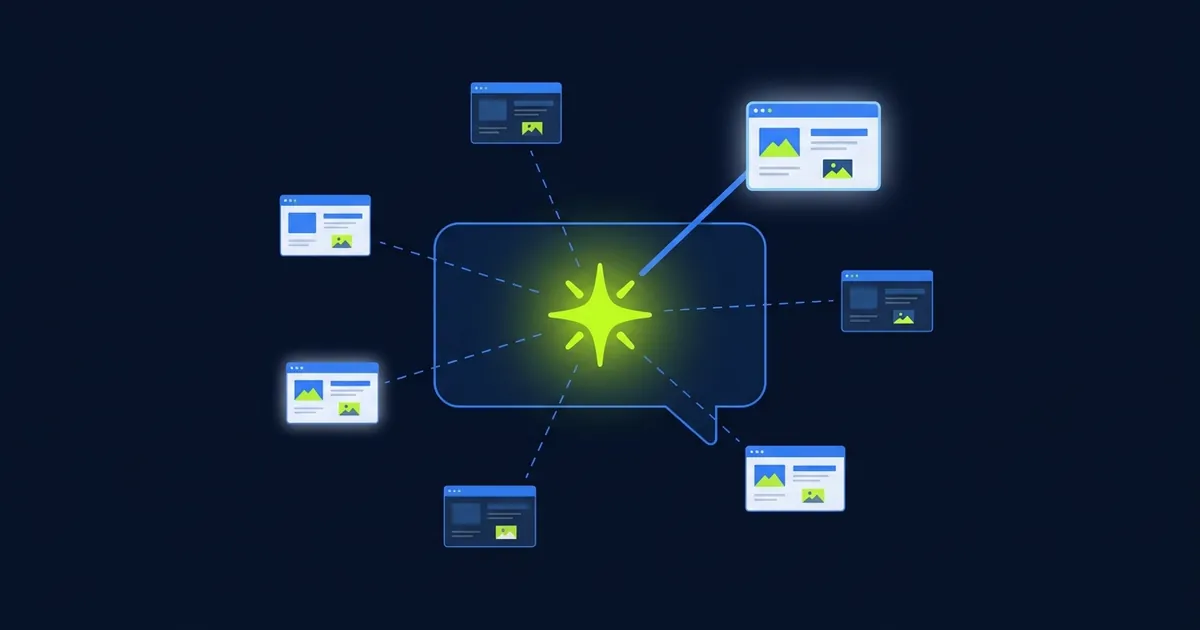
Generative Engine Optimization (GEO) is the practice of making a brand show up as a cited or recommended source inside AI-generated answers: Google AI Overviews and AI Mode, ChatGPT search, Gemini, Perplexity and Microsoft Copilot. Traditional SEO earns a link in a list of results. GEO earns a mention, a citation or a recommendation inside the answer itself.
I've spent the last few years doing both kinds of work for clients in the US, UK, Europe and Bangladesh. The short version of what I've learned: GEO is not a new trick that replaces SEO. It is SEO's foundation plus three things most sites have neglected for years, namely clear identity, quotable content and independent proof. This guide walks through all of it.
Why GEO matters now
AI answer engines change what a "visit" looks like. A buyer who once typed "best roofing contractor near me" and clicked three results may now ask an assistant a full question, read a synthesized answer and contact the one or two businesses it names. If your brand isn't in that answer, you were never in the running.
Three shifts make this urgent:
- Answers come before links. Google shows AI Overviews above traditional results for many informational queries, and AI Mode gives a full conversational answer. ChatGPT, Gemini and Perplexity answer first and cite second.
- Fewer sources get named. A results page shows ten organic links. An AI answer usually cites a handful of sources and names even fewer brands. The competition for those slots is tighter.
- Buyers ask longer questions. People describe their situation to an assistant ("I inherited a house in Pennsylvania and need to sell it fast, what are my options?"). Content written for two-word keywords rarely answers that well.
None of this makes rankings irrelevant. It makes them the entry ticket rather than the finish line.
How generative engines produce an answer
To optimize for something, you need a working model of how it behaves. Every major AI answer engine follows roughly the same pipeline, even though the details differ and change often:
- Understand the question. The system interprets intent and often expands one question into several sub-queries (Google calls this "query fan-out" in AI Mode).
- Retrieve candidates. It searches an index, either its own or a partner's, for pages that match those sub-queries. This is classic information retrieval, and it's why indexing and relevance still matter.
- Select passages. From the retrieved pages it picks the passages that answer each part of the question most clearly.
- Generate and attribute. The model writes an answer from those passages and, depending on the product, links or names the sources it relied on.
I go deeper into each step in how AI search engines choose which sources to cite. For now, notice where you can influence the outcome: you can make your pages retrievable (step 2), make your passages the clearest answer (step 3) and make your brand the one the model trusts enough to name (step 4).
GEO vs SEO vs AEO
The three terms overlap, and agencies use them loosely. Here is how I separate them in practice:
| SEO | AEO | GEO | |
|---|---|---|---|
| Goal | Rank pages in search results | Be the direct answer | Be cited or recommended in AI answers |
| Where you win | Google and Bing results | Featured snippets, People Also Ask, voice | AI Overviews, AI Mode, ChatGPT, Gemini, Perplexity |
| Main levers | Crawlability, relevance, links | Question-and-answer structure | Entity clarity, quotable passages, corroboration |
Answer Engine Optimization is the content half of GEO: it makes passages easy to lift. GEO adds identity and reputation on top. If you want the long version, read SEO vs AEO vs GEO.
The five pillars of GEO
Every GEO engagement I run is organized around five pillars. Skipping one usually caps what the others can achieve.
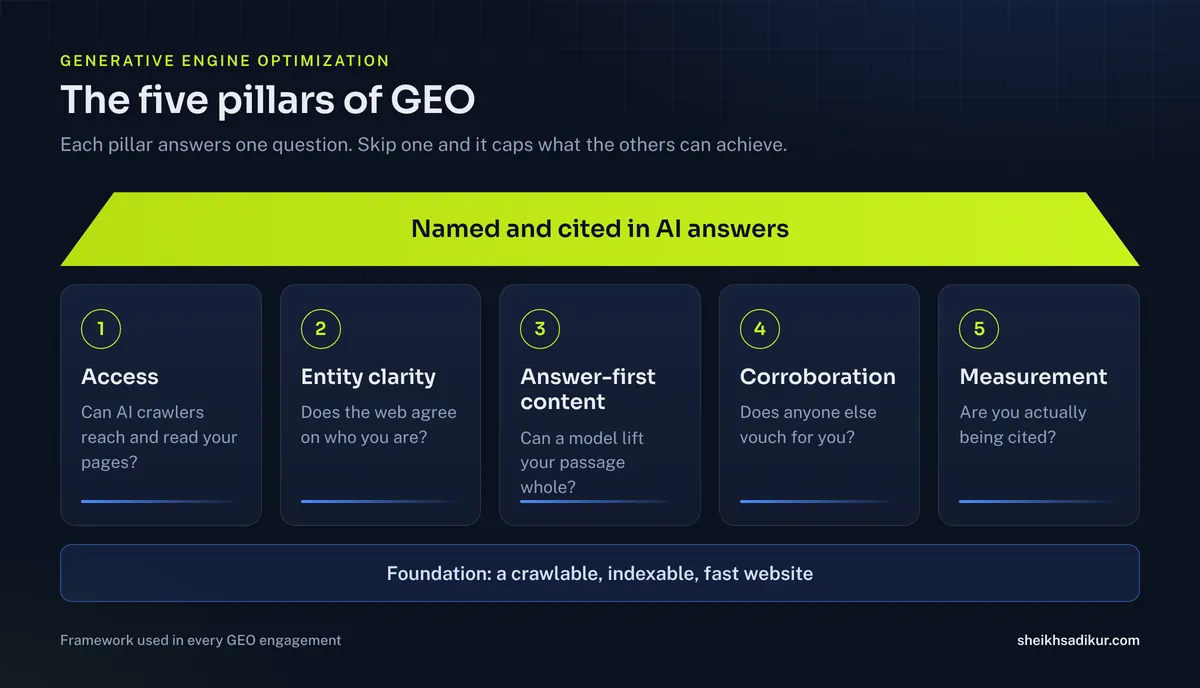
1. Access: can AI systems reach and read your pages?
This is the technical layer, and it's where I find the most surprising problems. In one real estate project, 252 internal resources were blocked in robots.txt, so search engines couldn't render pages properly (case study). For a UK car dealer, the homepage returned "This site is blocked from indexing", which meant zero search traffic and zero chance of AI citations (case study).
Access checklist:
- Pages return 200 status codes, are indexable and listed in an XML sitemap.
- robots.txt allows the search and retrieval crawlers you want to be cited by, such as OAI-SearchBot and PerplexityBot. I cover each bot in AI crawlers, robots.txt and llms.txt.
- Important content is in the HTML, not injected only by JavaScript after load.
- Your firewall or CDN isn't silently blocking AI user agents.
- The site is verified in both Google Search Console and Bing Webmaster Tools, since several assistants draw on Bing's index.
2. Entity clarity: does the web agree on who you are?
Language models reason about entities: people, companies, products and places, and the relationships between them. If your site says "digital marketing agency", your LinkedIn says "SEO consultant" and a directory lists an old address, the model has three conflicting descriptions and little reason to trust any of them.
Entity work means one consistent description of who you are, what you do and where, repeated across your website, social profiles, directories and Google Business Profile, then tied together with Organization or Person schema and sameAs links. The full method is in my entity SEO guide.
3. Answer-first content: can a model lift your passage whole?
AI systems prefer passages that answer a question completely in a few sentences. Long introductions, vague claims and answers buried in paragraph six lose to a competitor who puts the answer first.
The format I use on client pages:
- A heading phrased as the question a buyer asks.
- A direct answer of about 40 to 60 words immediately under it.
- Detail after that: steps, conditions, a table or a short list.
- Proof: a number, a source or first-hand experience.
In the real estate project, the monthly plan added 13 FAQ answers to four core pages in exactly this format and organized content into 7 topic categories built around real seller situations. The AEO guide shows how to write these blocks.
4. Corroboration: does anyone else vouch for you?
This is the pillar most sites are weakest on, including many with good rankings. AI systems favor claims they can verify across independent sources: reviews, press mentions, expert quotes, directory listings, conference talks and links from relevant sites.
Corroboration is closer to digital PR than to old-school link building. A mention in a trade publication that describes what you do is valuable even without a link, because it confirms your entity. My approach is in link building for AI search.
5. Measurement: are you actually being cited?
You can't manage what you don't track, and AI visibility doesn't show up neatly in one dashboard. I build a fixed set of 20 to 50 prompts that real buyers ask, run them across the main assistants every month, and record who gets named and which URLs get cited. Combined with AI referral traffic in analytics and impressions in Search Console, that gives a trend you can act on. Details are in how to measure AI search visibility.
What GEO is not
A lot of GEO advice is recycled SEO folklore or pure speculation. A few corrections from the work I've done:
- It's not keyword stuffing for chatbots. Repeating "best GEO expert" doesn't make a model recommend you. Clear, specific, verifiable content does.
- It's not a single file. llms.txt is a lightweight, emerging convention. Google has said it doesn't use it, and no major engine has confirmed it as a ranking factor. I add one because it's cheap and harmless, not because it's a strategy.
- It's not guaranteed. AI answers vary by phrasing, user, location and even between runs of the same question. Anyone promising "guaranteed ChatGPT placement" is selling something that doesn't exist.
- It's not separate from your website quality. A slow, thin or technically broken site doesn't become citable because you added schema.
A practical 90-day GEO plan
Here is the order I follow for most clients. Adjust the timing to the size of the site.
Days 1 to 15: baseline and access
- Run a full technical SEO audit and fix anything that blocks crawling or indexing.
- Check robots.txt, CDN and firewall rules for AI crawlers.
- Verify the site in Bing Webmaster Tools and submit the sitemap.
- Build the prompt set and record a baseline: which brands and URLs AI answers cite today.
Days 16 to 45: identity and core pages
- Write one canonical description of the business and update every profile to match.
- Add Organization or Person schema with
sameAs, plus Service, Article and FAQPage markup where it fits. - Rewrite the five to ten pages that should be cited, answer-first.
- Add FAQ sections built from real customer questions.
Days 46 to 90: corroboration and iteration
- Publish one piece of original data or first-hand experience that others would want to reference.
- Start expert sourcing: answer journalist requests in your field two or three times a day.
- Pursue a handful of high-relevance guest contributions and directory listings.
- Re-run the prompt set monthly and adjust the content plan based on who is being cited.
Common GEO mistakes I see in audits
Most of the problems I find aren't exotic. They're basic gaps that matter more once AI systems are choosing a handful of sources instead of showing ten links:
- Thin "about" information. The site never says plainly who runs the business, where it operates and what it's qualified to do. A model can't recommend an entity it can't describe.
- Answers hidden in marketing copy. The page technically answers the question, but only after three paragraphs about "passion" and "solutions". The competitor whose answer comes first gets quoted.
- One page per topic, competing with itself. Three blog posts half-answer the same question, so none of them is the clear source. Consolidating into one strong page usually works better.
- No proof. Claims like "we get results" with no numbers, examples or third-party confirmation. Specific, verifiable details are what make a passage worth citing.
- Blocking crawlers by accident. A security plugin or CDN rule that blocks unknown bots also blocks the AI search crawlers you want.
- Ignoring Bing. Sites verified only in Google Search Console miss problems that affect assistants drawing on Bing's index.
Fixing these rarely needs new technology. It needs someone to read the site the way a skeptical machine would.
How long GEO takes
The timeline depends on which pillar is holding you back:
- Access fixes can show effects within days to weeks once pages are recrawled.
- Content rewrites typically need several weeks to be recrawled, re-indexed and picked up.
- Corroboration builds over months, because third parties publish on their own schedule.
When a site already ranks well, answer-first rewrites can lead to citations relatively quickly. When a site has weak authority, the third pillar usually decides the pace.
Who needs GEO most
GEO pays off fastest for businesses whose buyers research before contacting anyone:
- Professional and B2B services where buyers ask detailed questions before shortlisting vendors.
- Local service businesses whose customers increasingly ask assistants for recommendations.
- E-commerce stores in specific niches, where AI answers compare products by specification.
- Experts and consultants whose personal reputation is the product.
If your customers never research online, GEO matters less. For almost everyone else, it's becoming part of basic visibility.
Frequently asked questions
Is GEO replacing SEO?
No. AI answer engines retrieve pages from search indexes, so indexing, relevance and authority still decide whether you're even considered. GEO builds on SEO and adds entity clarity, answer-first content and third-party corroboration so AI systems choose your page as a source.
Can you guarantee my brand will appear in ChatGPT or AI Overviews?
No one honestly can. AI answers change by question wording, user and run. GEO raises the probability that your pages are retrieved, quoted and trusted, and progress is measured against a fixed set of real buyer questions over time.
Does llms.txt help with GEO?
Only a little, if at all. llms.txt is an emerging convention that lists your key pages for AI tools. Google has said it doesn't use it, and no major AI search engine has confirmed it as a ranking factor. It's a low-cost addition, not a strategy.
How much does GEO cost?
It depends on scope. I include GEO and AEO in the Standard Authority retainer at $999 per month, and one-off audits can be ordered separately. The biggest cost driver is usually corroboration work, since earning third-party mentions takes sustained effort.
What should I do first?
Check access. Make sure your important pages are indexed in Google and Bing, robots.txt allows the AI search crawlers you want, and content is visible in the HTML. Then build a prompt set so you know where you stand before changing content.