Generative Engine Optimization
Entity SEO: How to Make Google and AI Understand Who You Are
Search engines and language models don't just match words, they reason about things: people, businesses, places and how they relate. If the web can't agree on who you are, neither can they.

Sheikh Sadikur, SEO, AEO & GEO consultant
Published · 9 min read
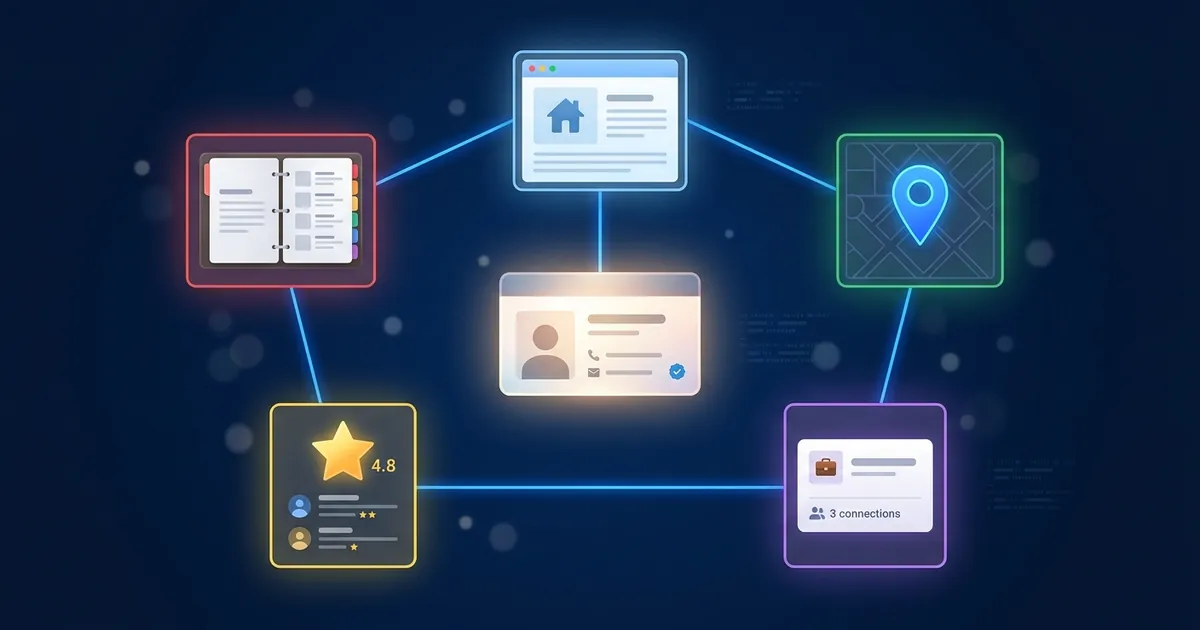
Entity SEO is the work of making search engines and AI systems recognize your business or personal brand as one clearly defined thing, with consistent facts about what it is, what it does, where it operates and how it relates to other things. You do it by publishing one canonical description, aligning every profile and listing with it, connecting those sources with structured data and earning independent mentions that confirm it.
Most SEO advice is about pages and keywords. Entity SEO is about identity. It matters more now because AI answer engines don't just rank pages: they describe and recommend entities. When someone asks an assistant "who is a good GEO consultant in Bangladesh", the model is choosing between entities it has a clear picture of. If yours is blurry, you're easy to skip.
What an entity is
An entity is a uniquely identifiable thing: a person, an organization, a place, a product, an event or a concept. "Sheikh Sadikur" is an entity. So is "Dhaka", "Semrush" and "Google Business Profile". Entities have attributes (a founding date, an address, a job title) and relationships (a person works for an organization, an organization is located in a city, a service is offered by a business).
Google has organized information this way for years through its Knowledge Graph, which powers knowledge panels and many search features. Language models also build internal representations of entities from everything they read, and AI search products retrieve information about entities at answer time.
The practical consequence: the more consistent and well-connected the information about you, the more confidently search engines and AI can describe and recommend you.
Signs your entity is unclear
From client audits, these are the symptoms I see most:
- Searching your brand name shows mixed results: a different business with a similar name, old profiles, or nothing relevant.
- AI assistants describe your business inaccurately, with old services, wrong location or a confused mix of facts.
- Your business name appears in several forms: with and without "Ltd", abbreviations, old brand names.
- Your address or phone number differs between your website, Google Business Profile and directories.
- Your social bios each describe what you do differently.
- There's no page on your website that plainly states who runs the business and what it does.
Any one of these is minor. Together, they make you hard to identify.
Step 1: write your canonical description
Everything in entity SEO starts with one agreed set of facts. I write this as a short reference document for every client before touching anything else.
It includes:
| Attribute | Example (my own) |
|---|---|
| Official name | Sheikh Sadikur Rahman |
| Name used professionally | Sheikh Sadikur |
| One-line description | SEO, AEO and GEO expert based in Dhaka, Bangladesh |
| What you do | SEO, Answer Engine Optimization and Generative Engine Optimization services |
| Who you serve | Businesses in Bangladesh and clients worldwide |
| Location | Dhaka, Bangladesh |
| Website | https://sheikhsadikur.com/ |
| Key profiles | LinkedIn, X, Facebook, Instagram, Fiverr |
| Proof points | 5+ years since 2020, 250+ projects, 5.0 from 161 Fiverr reviews |
Then write three versions of the description: one sentence, two to three sentences, and a full paragraph. Every profile will use one of these, word for word or nearly so.
Two details matter more than people expect:
- Pick one name format and stick to it. If you use a longer official name somewhere, mark it as an alternate name in schema, as I do with "Sheikh Sadikur Rahman" and "Sheikh Sadikur".
- Be specific. "Digital marketing services" describes thousands of businesses. "Technical SEO audits and toxic backlink cleanup for small businesses" describes far fewer, which makes you easier to match to specific questions.
Step 2: make your website the source of truth
Your own site should state your canonical facts more clearly than anywhere else, because it's the one source you fully control.
What I check:
- A clear about section or page stating who you are, what you do, where and since when, with a real photo.
- Your homepage's first screen says what you do and where in plain words.
- Contact details match exactly what appears on your profiles.
- Author information on articles: name, role and a link to the about page.
- Consistent naming across titles, footers and structured data.
On my own site, the hero line states "SEO, AEO & GEO expert in Bangladesh, serving clients worldwide", and the same description appears in the structured data, the footer and every profile.
Step 3: align every profile and listing
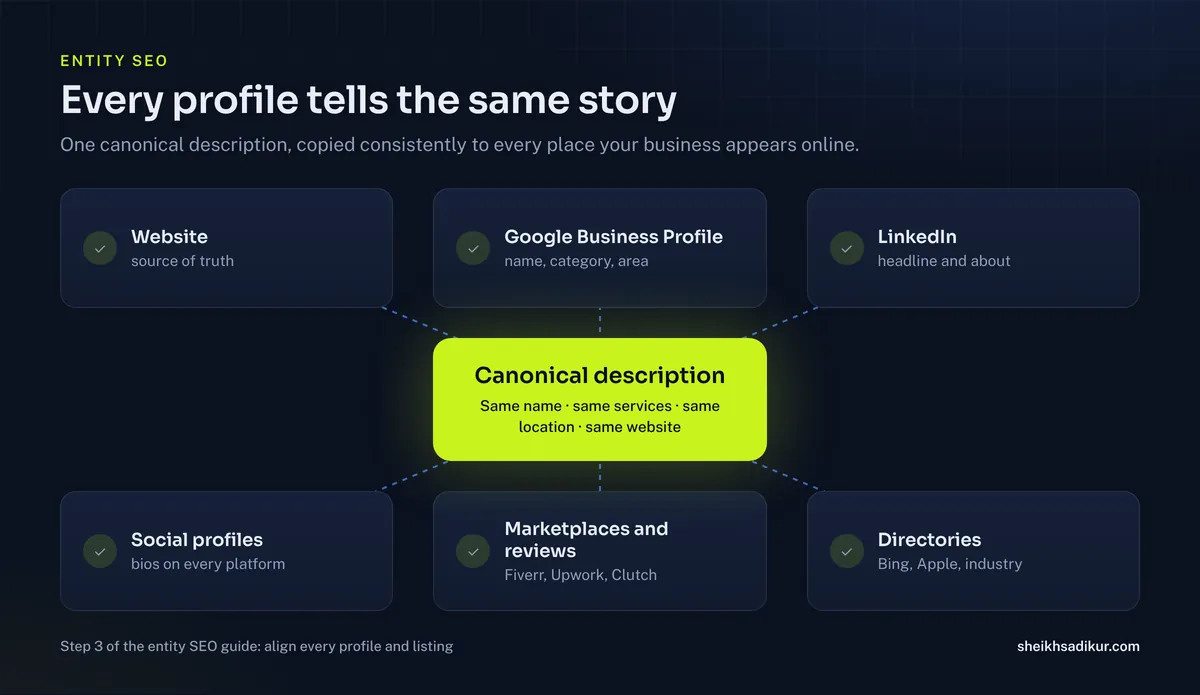
Next, go through every place your business appears online and make it match the canonical description:
- Google Business Profile. Name, categories, description, service area, website, phone. See the Google Business Profile guide for the details, including the rules about names and addresses.
- LinkedIn: personal headline, about section, and company page if you have one.
- Other social profiles: X, Facebook, Instagram, YouTube bios.
- Marketplaces and review platforms: Fiverr, Upwork, Clutch, GoodFirms or your industry's equivalents.
- Directories: Bing Places, Apple Business Connect, and relevant industry and local directories.
- Old profiles: update or close accounts that show outdated names, addresses or services.
Keep a spreadsheet of every profile with its URL and the date you last updated it. When something changes, such as a move or a new service, update all of them in one sitting. I've seen a business move house, update its website and leave the old address on its Business Profile for months; that split signal is exactly what entity SEO tries to prevent.
Step 4: connect the sources with structured data
Structured data tells machines explicitly that these sources describe the same entity. The key property is sameAs: a list of URLs of profiles that represent the same person or organization.
A simplified version of the Person markup on my homepage:
{
  "@context": "https://schema.org",
  "@type": "Person",
  "@id": "https://sheikhsadikur.com/#person",
  "name": "Sheikh Sadikur Rahman",
  "alternateName": "Sheikh Sadikur",
  "jobTitle": "SEO, AEO & GEO Expert",
  "url": "https://sheikhsadikur.com/",
  "address": { "@type": "PostalAddress", "addressLocality": "Dhaka", "addressCountry": "BD" },
  "alumniOf": { "@type": "CollegeOrUniversity", "name": "University of Liberal Arts Bangladesh" },
  "sameAs": [
    "https://www.linkedin.com/in/sheikh-sadikur-rahman/",
    "https://x.com/SheikhSadikur",
    "https://www.facebook.com/sheikhsadikurrahmandm",
    "https://www.instagram.com/sheikh_sadikur_rahman",
    "https://www.fiverr.com/sadikur24"
  ]
}
Good practices:
- Use a stable
@id(like/#personor/#organization) and reference it from other markup, such as the author of every article and the provider of every service. This ties your whole site to one entity. - List only profiles you control and that describe the same entity.
- Add
knowsAboutwith topics you're expert in, ideally linked to well-known definitions, to make your expertise explicit. - Keep it in sync with the visible content. Structured data that contradicts the page undermines trust.
The broader set of markup I use is in schema markup for AI search.
Step 5: earn independent corroboration
Everything so far is you describing yourself. The strongest entity signals come from others describing you in the same way:
- Reviews on platforms you don't control, mentioning your services and location.
- Editorial mentions in articles, interviews or podcasts that state who you are and what you do.
- Expert quotes where a journalist names you with your role.
- Listings on industry associations, event speaker pages or university pages.
- Links from relevant sites that use your name as the anchor text.
When an independent source repeats your canonical description, it confirms your entity. That's why, for GEO, I treat brand mentions as valuable even without a link. My approach to earning them is in link building for AI search.
Step 6: consider knowledge bases carefully
Wikipedia and Wikidata are heavily used sources for entity information. They have strict notability and conflict-of-interest rules:
- Don't write your own Wikipedia article. It's against Wikipedia's policies and is usually removed.
- Wikidata has lower notability thresholds but still requires verifiable references. An item without independent sources may be deleted.
- For most small businesses and consultants, the realistic path is to earn independent coverage first. If it becomes substantial, others may create entries.
Entity SEO for local businesses
For local businesses, the entity includes location data, and consistency matters even more:
- NAP consistency (name, address, phone) across your site, Business Profile and directories.
- Service-area clarity: if customers don't visit you, list service areas rather than a public address, and make your site say the same.
- LocalBusiness or ProfessionalService schema that matches your Business Profile exactly.
- Local corroboration: local news, community organizations, chambers of commerce.
Entity SEO for consultants and personal brands
If you sell your own expertise, you are the entity buyers and AI systems evaluate. That changes the priorities:
- Your name is the brand keyword. Make sure searches for your name lead to your site and professional profiles, not to someone else with a similar name. A distinct professional name format, used consistently, helps.
- Credentials need to be visible. Education, years of experience, certifications and notable projects should be stated on your site and match your LinkedIn. For me, that means my journalism studies at ULAB, my start in SEO in 2020 and my case studies are stated the same way everywhere.
- Authorship ties content to you. Every article you publish should carry your name, link to your about information and reference your Person entity in its structured data. Over time, this connects your expertise topics to your name.
- Your public activity counts. Talks, interviews, podcast appearances and quotes in articles are some of the strongest corroboration a consultant can earn, because they show other people treating you as an expert.
- Keep personal and business entities linked but distinct. If you also run an agency, mark yourself as its founder in schema and keep both descriptions consistent.
How to check your progress
Entity work doesn't come with a score, but you can observe it:
- Search your brand name in Google. Over time you want your own site, profiles and relevant mentions to dominate the first page, and possibly a knowledge panel.
- Ask AI assistants "Who is [name]?" and "What does [business] do?" with search enabled. Check accuracy, not just presence.
- Check branded impressions in Search Console. Growing searches for your name reflect growing recognition.
- Audit profiles quarterly against your canonical description.
I fold these into the monthly tracking described in measuring AI search visibility.
A quick example
When I rebuilt my own site, the old WordPress version had different descriptions in different places, an old contact email on some pages and profile links that pointed to outdated URLs. The rebuild used one description everywhere: the homepage hero, the meta description, the Person schema, the footer, llms.txt and every social bio. Every article, service and case study now references the same #person entity as author or provider. It isn't glamorous work, but it's the foundation everything else in generative engine optimization depends on.
Common mistakes
- Treating it as a one-time task. Every move, rebrand or new service needs updating everywhere.
- Keyword-stuffing your name. "Best SEO Expert Dhaka - Sheikh Sadikur" as a business name confuses the entity and can break platform rules.
- Fake profiles and listings. Low-quality directory blasts add noise, not clarity.
- Schema that doesn't match the page. It's a credibility problem, not a shortcut.
- Ignoring the person behind the business. For consultants and small firms, the founder's personal entity often matters as much as the company's.
Frequently asked questions
What is the difference between entity SEO and regular SEO?
Regular SEO focuses on making pages rank for keywords. Entity SEO focuses on making search engines and AI systems understand your business or brand as one clearly defined thing, with consistent facts across the web. Both matter, and entity clarity increasingly decides who AI assistants describe and recommend.
Do I need a knowledge panel for entity SEO to work?
No. A knowledge panel is one visible sign that Google recognizes an entity, but many businesses are understood well without one. Focus on consistent information, connected profiles and independent mentions. A panel may follow, but it isn't the goal.
What is sameAs in schema markup?
sameAs is a schema.org property that lists URLs of profiles representing the same entity, such as LinkedIn, social accounts and marketplace profiles. It tells machines explicitly that these pages describe the same person or organization as your website.
How long does entity SEO take?
Updating your site and profiles takes days. Search engines and AI systems reflect the changes as they recrawl, typically over weeks. Independent corroboration builds over months, and that is usually what moves an entity from understood to trusted.
Should I use my personal name or business name?
Use whichever your customers actually search for and buy from. Many consultants need both: a Person entity for themselves and an Organization entity for the business, linked to each other in schema. Keep each one consistent everywhere.