Generative Engine Optimization
How AI Search Engines Choose Which Sources to Cite
Every AI answer engine runs the same basic pipeline: interpret, retrieve, select, generate, attribute. Once you see the pipeline, it becomes clear which parts of your site and reputation decide whether you're cited.

Sheikh Sadikur, SEO, AEO & GEO consultant
Published · 9 min read

AI search engines choose sources in two stages. First they retrieve candidate pages from a search index that match the question and its sub-questions. Then they select the passages that answer each part most clearly and credibly, write an answer from them, and attribute some of those sources with a link or a mention. Your page needs to survive both stages to be cited.
That sounds simple, but each stage has its own failure points. In audits I see sites that rank on page one yet never get cited, and smaller sites that get cited constantly because their passages are cleaner. This article explains the mechanism and what each step means for your content.
The pipeline behind every AI answer
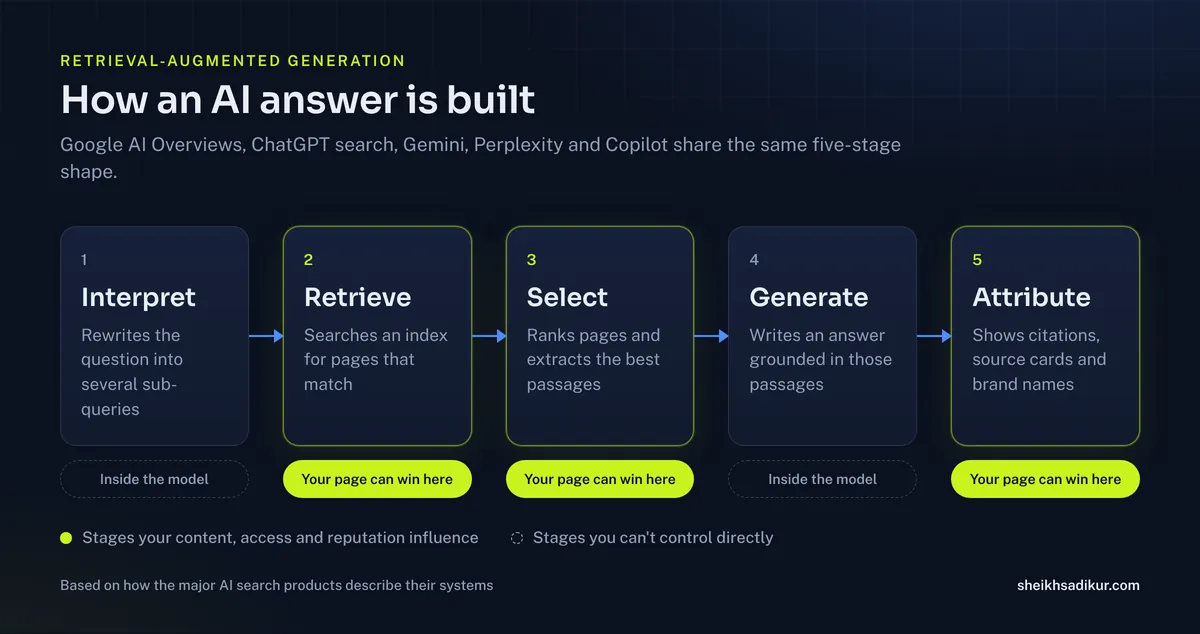
Google AI Overviews and AI Mode, ChatGPT search, Gemini, Perplexity and Copilot are different products, and none of them publishes its full ranking logic. But they share an architecture usually called retrieval-augmented generation (RAG): the model doesn't answer purely from memory, it looks things up first.
- Interpretation. The system works out what the user wants, often rewriting the question and splitting it into several sub-queries.
- Retrieval. It searches an index for documents matching each sub-query.
- Ranking and passage selection. Retrieved documents are ranked, and specific passages are extracted.
- Generation. The language model writes an answer grounded in the selected passages.
- Attribution. The product shows citations, source cards or brand mentions.
You can't control the model. You can control what it finds at step 2, what it reads at step 3 and how your brand looks when it decides what to name at step 5.
Stage 1: interpretation and query fan-out
When someone asks "what's the fastest way to sell an inherited house in Pennsylvania?", the system doesn't search that sentence once. It may search for probate rules, inherited property taxes, cash buyers versus realtors and timelines. Google has described this behavior in AI Mode as query fan-out.
Two consequences matter for content:
- Sub-topic coverage counts. A page that answers the main question plus the obvious follow-ups (taxes, timelines, costs, alternatives) has more chances to be retrieved for one of the fanned-out queries.
- Conversational phrasing matters. Fan-out queries are closer to natural questions than to two-word keywords. Headings phrased as real questions match them better.
This is why, for a real estate client, I built 7 topic categories around real seller situations (foreclosure, inherited property, divorce, selling as-is and so on) rather than one generic "sell your house" page. Each situation is a likely sub-query.
Stage 2: retrieval
Retrieval is where classic SEO lives. If your page isn't in the index the engine searches, nothing else matters.
Which index?
- Google AI Overviews and AI Mode draw on Google's search index. Google states there are no special technical requirements beyond being indexed and eligible to show a snippet in Search.
- ChatGPT search uses its own crawler (OAI-SearchBot) and third-party search providers. Bing has historically been among them, which is one reason I verify every client in Bing Webmaster Tools.
- Perplexity runs its own crawler (PerplexityBot) and index alongside other sources.
- Copilot is built on Bing.
What blocks retrieval
The failures I find most often:
- Pages that are
noindex, canonicalized elsewhere or missing from the sitemap. - robots.txt or firewall rules blocking the relevant crawler. See AI crawlers and robots.txt for the full list.
- Content rendered only by JavaScript, which some crawlers don't execute.
- Pages Google has crawled but chosen not to index. I cover the causes in crawled, currently not indexed.
- Snippet controls such as
nosnippetor a very lowmax-snippet, which Google says also limit use in AI features.
A technical SEO audit is the fastest way to rule these out.
Stage 3: ranking and passage selection
Once candidates are retrieved, the system decides which passages to use. This is where well-ranked pages often lose to clearer ones.
What makes a passage selectable
From the content that does and doesn't get cited in client projects, these properties consistently help:
- The answer comes first. A 40 to 60 word direct answer right under a question heading is easy to extract without rewriting.
- It stands alone. The passage makes sense without the paragraphs around it: no "as mentioned above", no undefined pronouns.
- It's specific. Numbers, names, conditions and steps beat generalities. "Mobile Largest Contentful Paint dropped from 5.0s to 1.5s" is more citable than "the site got much faster".
- It's structured. Lists, tables and step sequences map neatly to how answers are composed.
- It's current. Visible dates and up-to-date facts matter for topics that change.
Why rankings aren't enough
A page can rank for a keyword because of strong links and still lose passage selection because the answer is buried. I regularly see a competitor's well-structured FAQ quoted in an AI Overview while a higher-ranking page with a 2,000-word wall of text isn't. The fix is usually editorial, not technical: restructure the page answer-first, as described in the AEO guide.
Stage 4: generation and the trust filter
When the model writes the answer, it leans toward sources that look reliable. No engine publishes a trust score, but the signals line up with what search engines have rewarded for years, plus a few that matter more for language models.
Consistency across sources
Language models are trained on and retrieve from many documents. If your website, LinkedIn, directories and press mentions describe you the same way, the model has a coherent picture of your entity. If they conflict, it has reasons to hedge or pick someone else. That's the core of entity SEO.
Independent corroboration
A claim you make about yourself is weaker than the same fact stated by an independent source. Reviews, editorial mentions, expert quotes in articles, conference listings and links from relevant sites all act as corroboration. This is why GEO overlaps heavily with digital PR. My approach is in link building for AI search.
Clear authorship and expertise
Pages that show who wrote them, why that person is qualified and when the content was updated give both search engines and models more to work with. Anonymous content with no dates is harder to trust.
Stage 5: attribution
Not every source the model reads gets a visible citation. Products differ in how they attribute:
| Product | How sources usually appear |
|---|---|
| Google AI Overviews | Linked source cards beside or under the answer |
| Google AI Mode | Inline links and a source list |
| ChatGPT search | Inline citations and a sources panel |
| Perplexity | Numbered citations for each claim |
| Gemini | Source links when grounded in search |
Two practical points:
- Brand mentions count even without a link. If an assistant recommends your business by name, that's valuable even when the citation points to a directory or review site that mentions you.
- Citations are volatile. The same question can return different sources on different days or for different users. Judge progress over many prompts and months, not one screenshot. I explain how in measuring AI search visibility.
What this means for your site
Mapping the pipeline to actions gives a clear priority list:
| Pipeline stage | What decides it | What to do |
|---|---|---|
| Interpretation | Coverage of sub-questions | Build topic clusters around real situations and follow-up questions |
| Retrieval | Indexing and crawler access | Fix technical blockers, allow AI search crawlers, verify in Bing |
| Passage selection | Clarity and structure | Answer-first sections, specific facts, lists and tables |
| Generation | Trust and consistency | Consistent entity data, visible authorship, dates |
| Attribution | Corroboration | Earn mentions, reviews and links from relevant sources |
Most sites I audit are strong on one or two rows and weak on the rest. The biggest gains usually come from the weakest row, not from polishing the strongest.
A worked example
Here's how the pipeline played out for the Pennsylvania cash home buyer I mentioned earlier.
Before: a small brochure site with Semrush Site Health of 84%, 4 errors and 337 warnings, and slow mobile pages. Content was generic: "we buy houses fast" without addressing specific seller situations.
What changed:
- Retrieval was fixed first. 252 blocked resources were unblocked in robots.txt, broken links and missing redirects were repaired, and Site Health reached 100% in 16 days.
- Interpretation coverage was expanded with 7 topic categories matching real seller situations, each with posts mapped to primary and voice-search keywords.
- Passage selection was improved by rewriting four core pages section by section and adding 13 FAQ answers in question-and-answer format.
- An llms.txt file and updated sitemap helped crawlers find the key pages.
The outcome I can report honestly is a technically clean, well-structured site built to be cited. The next step is tracking whether it appears in AI Overviews for its target questions, because citations take time to show and vary by query. You can read the full case study.
Freshness, dates and why "updated" matters
For topics that change, answer engines lean toward current information. A guide to Core Web Vitals that still treats First Input Delay as a Core Web Vital, years after Interaction to Next Paint replaced it in March 2024, is a weaker source than one that reflects the change.
What helps:
- Visible dates. Show when a page was published and when it was last meaningfully updated, and keep
datePublishedanddateModifiedin your structured data accurate. - Real updates, not date bumps. Changing the date without changing the content is easy to spot and erodes trust. Update facts, examples and screenshots, then update the date.
- Version-specific facts. Name the year, version or policy you're describing, so a model can tell your information apart from older pages.
Evergreen definitions need fewer updates. Anything involving product features, pricing, policies or platform rules should be reviewed at least twice a year.
A checklist to make any page citable
Before I consider a page ready to be a source, it passes these checks:
- Indexed in Google and discoverable by Bing, with no snippet restrictions.
- Allowed for the AI search crawlers you care about.
- Main content present in the HTML without depending on JavaScript.
- Each key question has its own heading, phrased the way people ask it.
- Each heading is followed by a direct answer that stands alone.
- Specific facts: numbers, names, conditions, steps.
- Clear author with relevant expertise, and visible dates.
- Structured data that matches the visible content.
- Internal links to deeper pages on each sub-topic.
- The same facts about your business here as on your profiles and directories.
A page that passes all ten isn't guaranteed a citation, but it removes every reason an engine has to skip it.
Common misconceptions
"AI engines only cite big brands." Big brands have an advantage in corroboration, but specific, well-structured answers from smaller sites get cited regularly, especially for niche or local questions where big brands have nothing useful to say.
"You need to write for the AI, not for people." The properties that make passages selectable (clarity, specificity, structure) are the same ones that make content useful to people. Writing awkwardly for machines usually makes both worse.
"Schema markup gets you into AI answers." Structured data helps machines understand what a page is and who is behind it, but it doesn't force inclusion. It supports the trust and entity signals; it doesn't replace them. See schema markup for AI search.
"Being in the training data is what matters." For current products with search grounding, retrieval at answer time decides most citations. Training data shapes what the model already believes about your brand, which is another reason consistent entity information across the web matters.
Frequently asked questions
Do AI search engines use Google rankings?
Google's AI Overviews and AI Mode draw on Google's own index and ranking systems, so pages that rank well have an advantage. Other engines such as ChatGPT search and Perplexity use their own crawlers and partner indexes, so strong Google rankings help but don't guarantee citations there.
Why does my page rank on Google but never appear in AI Overviews?
Usually because the answer isn't easy to extract. AI features select specific passages, so a page with the answer buried deep, no clear question headings or vague wording often loses to a competitor whose answer comes first. Snippet restrictions like nosnippet can also exclude a page.
How many sources does an AI answer usually cite?
It varies by product and query. AI answers generally cite a handful of sources rather than the ten links on a results page, and they name even fewer brands. That's why being the clearest and most trusted source for a specific question matters more than ranking broadly.
Can I see which of my pages are cited by AI?
Partly. Google Search Console includes AI feature appearances in its overall performance data, analytics can show referral traffic from AI products, and manual prompt testing shows which URLs get cited. No single tool gives the full picture, so I combine all three.